Padd Solutions

Converted by Falcon Hive

Showing posts with label OUGD104. Show all posts
This module has been an odd one for me. I did not really start engaging with the line brief until the start of the year. Obviously that was my fault and I should have addressed it, and has meant that I had to work harder in the last few weeks but still come out disappointed with the work I have at the end. I had a nice final piece, which was engaging and interesting but the whole module seems to have passed by quickly and I have not got the amount of work I had on the other modules. This may be because it has been running in the background appose to other modules which I could concentrate solely on.

1. What skills have you developed through this module and how effectively do you think you have applied them?

I have built on my illustrative skills. I am not the best at illustration and I have stuck with it and have got better I think. The sessions on create visual representations quickly really put my crafting to the test, as I am someone who would like a little longer when creating something that would have to be shown to the rest of the group. I pushed myself and in those sessions because I started out and my attempts were like a pre-schooler.

The workshops on the whole were based on things I had never attempted before and although I was skeptical to start with and I did wonder why I was doing some of the tasks I can now see how it benefited. The sequence sketches brought about interesting results as different people in the group interpreted words and phrases different to me, so it was interesting to see how they responded. I think I have got quicker at being able to visual multiple solutions to a problem through doing the sessions.

2. What approaches to/methods of research have you developed and how have they informed your design development process?
The method of research I have developed mostly is the quick response to a problem, and by coming up with multiple ideas or visual links to a keyword whether it be a noun, verb or phrase I have learned to think quickly and this has helped save me time trying to come up with one perfect idea.

In terms of secondary research and gaining inspiration, I haven't really changed much. I still close myself off a little and tend not to look at books and magazines as often as I should. I look at the theory rather than work I admire which I can apply to my own ideas.

3. What strengths can you identify in your work and how have/will you capitalise on these?
The amount of careful consideration I put into my work and I feel that, particularly in this module, on the what is a line? brief, my work has flowed nicely to a good conclusion. There was a little rut I got myself into when experimenting but I pulled it together in the final weeks and created a nice final which took me a long and hard time and a lot of money to complete.

As stated before I think my illustration has improved to the point where I could use my own illustrations to work from and create something clean and polished digitally.

4. What weaknesses can you identify in your work and how will you address these more fully?
I did some but not enough outside the sessions. For example the icons and schematic diagrams I could have done more of, or more in the way of photography because I am still a little unsure about working with a digital slr.

I could have had a bigger range of sketches and general investigation into other areas of what is a line rather than being narrow minded in the end. I just felt that natural lines was a wide enough subject to give me enough to work with. I should have also dedicated more time on the development of a final design rather than jumping straight into it.

The only way I could rectify this is to do it on the next module. I think I would normally but I have genuinely felt the pressure of the course. It has been difficult but it has been worth the effort.

5. Identify five things that you will do differently next time and what do you expect to gain from doing these?

Spend more time in the library looking at current trends and finding inspiration instead of doing my own logical layouts and taking inspiration subconsciously.

I don't think I could have managed my time better because but I could have perhaps put more time aside for this module. The what is a line stuff was running in the background and the back of my mind up until February, and that is just simply not good enough for someone who wants to set a high standard.

Apart from those I can't really fault myself. I try hard, I attended every session and came wanting to work and improve, even when the agenda of the session was to stick down coloured paper. I was out of my comfort zone but I never complained. I am hard on myself sometimes and I come to the end of the module thinking, have I done enough and how much has everyone else done. I think I could have spent more time outside the sessions on the pictogram and icon stuff cos I didn't get the 30 done because I simply could not think of anymore imagery. I did do a few resolutions digitally though.

6.How would you grade yourself on the following areas:
Attendance 5
Punctuality 4
Motivation 3
Commitment 3
Quantity of work produced 3
Quality of work produced 4
Contribution to the group 3
My quote was 'A mark indicating position, connection or boundaries.' and I believe this answers it pretty well.

This is my final resolution for the what is a line? brief. I have never envisaged doing something like this when I began the brief but it seems to fit and its an interesting subject, for me at least.

I laid the book out with digital illustrations of most of the people I got finger prints and hand photos from. I traced them by hand first and then digitised them later. Overall I love what I have done, and I think it's one of the better pieces I have done all year.

I decided to use acetate because I felt it was pleasing on the eye as well as quite functional. The reader could compare their hand with the examples in the book. The see through page allows them to do that.

The biggest job for doing this was the laying it out and the actual binding of it. It's not perfect like a commercial book would be but its nice for the purposes of the brief. Because of the way I bound it, using acetate then paper to make up the pages I had to include a middle spread where I put a fingerprint showcase. That came out better than expected, so I am really happy with it all.

Now all I have to do is complete some outstanding back up work and we'll be golden.
I had a last evaluation/presentation yesterday, and I presented my work to the rest of the group. All in all it went down ok, and filled the 5 minutes I had pretty well. After watching everyone else's presentation too, I haven't noticed any glaring mistakes in my work. I think at this point I have to concentrate on getting the final finished and fill in the gaps in my development work.

My main concern is finding contextual references to link my work into. Where I got my inspiration from, etc. The truth is I just got all the data I had collected and put it together on the page to see what fitted where and what was the best layout to use. I didn't trawl through loads of books thinking I could copy or take inspiration from someone else's style.

The next step is to make this module my main focus, despite having other things to finish such as the elective and the current module stuff, I think that those modules can wait a little until I have sorted the rest out. I really have to prioritise my time and think about what 'needs' to be done rather than what I want to do.
For the book I am creating I want to use some sort of graph like layout. These examples are not that exciting but I am hoping that my resolution encompasses some of the features of this. I don't want the book to be analytical in any way because that means that if I did not get the illustrations exact and to scale my information would be wrong. However, I do want to incorporate a key to define the lines and use a graph paper style layout to pin point where lines meet and cross. So these examples are good for inspiration in that sense.
I have been looking at how I could incorporate pictograms into what I already have. These could be positioned on the page where some of the less important lines are on the hand. I couldn't tell you who the designer is but it seems to fit in with the clean style I'm working with. The pictograms in book would represent hobbies of the person's hand on the page.


So, the final crit came and so did a few other problems... for me. The first thing that was said that my work was engaging and made the reader look at their own hand and compare the information. This was never intended as a palm reading guide so I am happy people do engage with it. Other issues were apparent too because of the continuity. My book was supposed to show the same theme on each page so it could be comparative.

One issue raised straight away was the fact people did not know what the book page was meant to be. I don't know if this is a good thing or a bad thing. Perhaps, it does not matter because it will become apparent when the book is produced.

Nichola, David and Tom threw ideas into the mix and advised to maybe look at using different ways to show identity. In the eyes, for example or other body parts. David suggested using a pictogram style which would replace the lines with hobbies and interests. This would work and I will look into it but to get all of this done in a week could be (will be) hazardous.

One idea I did think of during the crit was to use an eye and split it into sections like a pie chart.

Other suggestions were made but I think I know what I have to do. Some of the suggestions are more realistic than others.
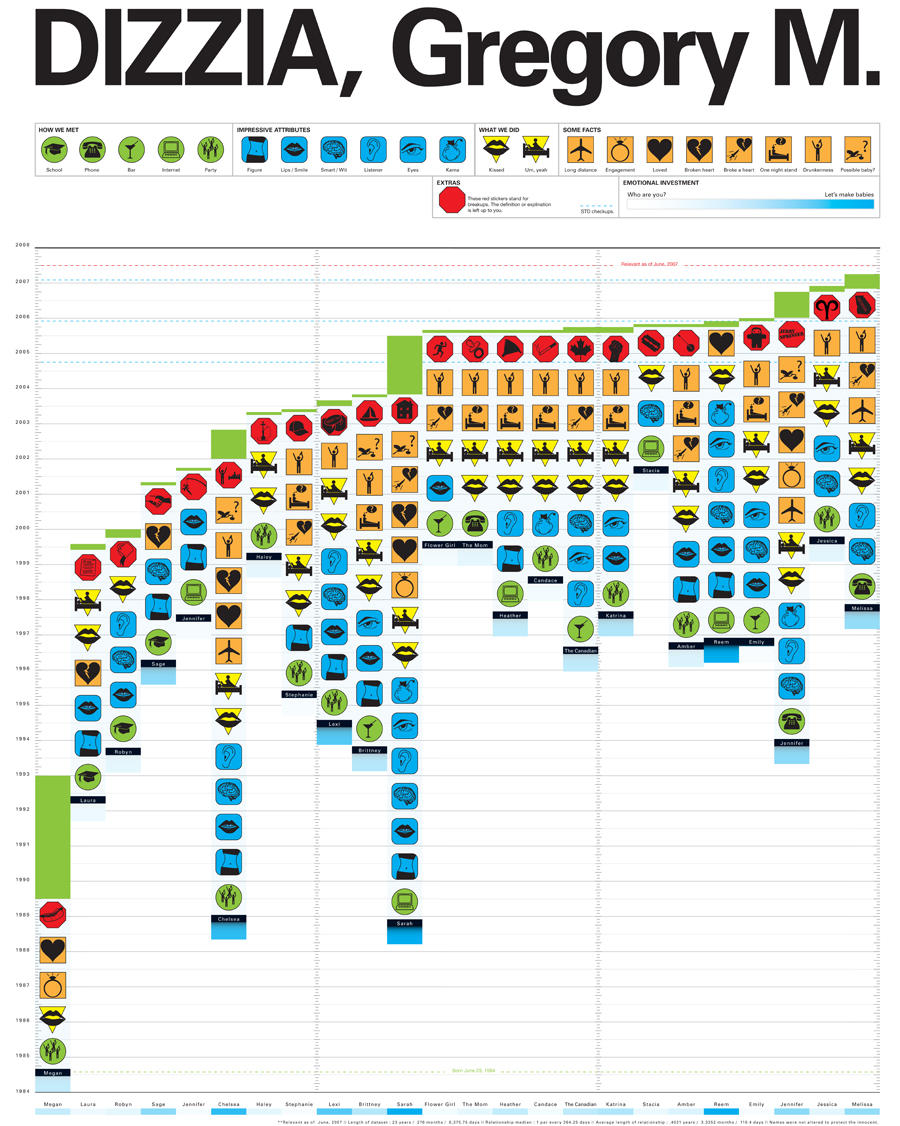
After searching the internet for good examples of diagrams and maps, I stumbled across this Feltron annual report. It certainly appeals to me in the sense that dull and boring figures can be presented in aprofessional yet visually interesting way. This report is actually a report of his life. These maps and diagrams reflect the travel, photography, music, food, drink and reading contained in the year.


There are many more examples at Feltron.com
I found this awesome book thanks to David, and I am just flicking through to find relevant examples which I can work into my own stuff. Now that I actually have some sort of format and subject, I am trying to focus down my investigation which has been all over the place in recent weeks. I have had no sense of time management on this and was confused about the outcome until last week. I do have some examples from the book but I am unsure as to whether they really do inform my design decisions.

I want to create a book which illustrates identity. I have had to move quickly on this so I extracted the fingerprints of 16 people and also took a photograph of their palm. I have formulated a page design which I want to have a continuous theme but not be boring. I have had to amend the rules as without the colour the piece just would not work.

I want the book to come to sort some of analytical end but I am unsure of what form that will take. I have had an eternity on this project but its been hard to get my head around, and actually focus on one specific area. Now that the focus is in place I can move on.
I found this guide book in the library all about perspective. It could be really helpful, so I'll post up some scans. It has loads of examples which might be useful to my development. It has examples from basic perspective to more creative perspective and everything in between..

This is a very basic example of perspective showing what the eye sees from 2 different angles.


These are two examples from the book of simple one point perspectives.


This next example includes tonal shading as well as a two point perspective.


I have been doing some research into the subject as an extension on the session we had as part of the visual language module. I found a book in the library called 'Pictograms Icons and Signs' and I must say it has been helpful when developing my own sketches. Mine were a little complicated so I have used the book to work on my own into something more professional looking.


These icons are a great example of commercial icons which were used in the yellow pages. Even without colour we still have a good indication into what the icons represent.


So, I come back with renewed hope and an idea of what I would like to do for the next part of this investigation. My experiments have been lacking and I need to tighten up on this project. I am still confused as to what I have to actually produced for this as my brief says nothing about target audience and the fact that this project has to come to a head with some sort of product or final piece. I was assured in the crit that I needed a target and a focus so this should hopefully clear that up.

I have decided upon using identity as the focus of the brief, and continuing my investigation into line using natural lines. I'd like to create some sort of book of illustrations which will look at the differences in hand lines and also finger prints. I want to take photographs of peoples hands and also get an finger print from them. I will then use digital illustration and copies of the finger prints and focus one page per person. Analysis will go with the hand lines to show the various lines a palm reader uses when telling fortunes.

As for the target audience, first and foremost the people featured in the book would undoubtedly have an interest and other people who could be interested in the book could range from people interested in spirtual enlightenment to those who are interested in science and nature.

The questions I got back from Leigh, Mitch, Alex and Lauren were all suggesting I keep to the natural theme in one way or another, so I this only reinforces my decision to keep on track with this and leave behind the landart which was beginning to seem more like a fine art approach.

Rules = Can only use 4 colours + stock
No photography
Has to be a book
I had a little presentation crit and I thought I was doing ok, even though I had not really spent as much time as I would have liked on this brief. I explained what I was trying to do, and I feel as though I have become lost in experimentation, which I thought was a good thing, but I have to almost reign myself in and restrict my work to something with more focus. I need a target audience and a final piece at the end of the brief, something which I haven't thought about. I am annoyed with myself because I should have thought about all of this instead of going off on a tangent with different experiments.

The only good to come of my wildness is that I have alot of experimentation to draw on and make some design decisions. I'm still enjoying studying Land art but I feel as though its something I am doing for myself rather than for a fixed audience. It's as though I thought this was going to be an investigation with an answer to 'what is a line?' but not to produce something of any substance.

The next thing you'll hear from me on this is when I finally make a decision on where this is going. I need to decide and quick!

These are a couple of images of a mini land art experiment I did. It all seems pretty pointless now though...
In this session we looked at lighting as well as using a light meter to get the correct exposure. Will, Jonny, Ed, Luke and I were all in a group together and were basically taken various shots to gain a better understanding. Jumping into the process of taking images was better than learning from a book and I felt this session could have lasted longer. I have a few examples of images taken but Will has the rest of them and I should have got more examples from him.

I was in some of the shots but these were the only ones I could find.


I had a session on this project yesterday, and after feeling as though I had something good going I was a little stuck for ideas. I have tried to combine mapping and natural lines from my hands to start with. I could only think after doing this how pointless it was. What did it mean? I am still unsure. So I have decided to really push the land art stuff and attempt to create my own pieces.

I want to keep the natural line stuff and maybe even create a finger print out of pebbles like a mini landart investigation.

Examples coming soon...
I have been researching into palm reading. I don't really have an opinion on it but I suppose there could be some truth in it. After looking at a rough guide and finding my career and life paths are quite short I felt a little down and then thought all of this palm reading malarkey could be total codswallop. Then again, my hands are quite big so maybe the lines are long and I'm over thinking it and in that case the love line is huge.

This is a nice easy example of how the palm is laid out and what lines you look at for different categories. I dare you not to try it out with your own palm. This also a decent example of using line to create a visual we can identify with, I think.


After looking at Goldsworthy, David suggested researching into Richard Long who is another sculptor/artist who works with what he can find. Where as Goldsworthy does a mixture of spontaneous simple sculptures and much more drawn out and methodical sculptures like the one with the tree in the video, Richard Long creates little sculptures along his travels. I like the fact that he does this for his own enjoyment rather than creating a piece of art that has some sort of meaning that then can be sold on. The landscape is his canvas and nature is his tools. From what I gather Long created these sculptures all over the world.

I found a quote that sums up his work quite well.

I consider my landscape sculptures inhabit the rich territory between two ideological positions, namely that of making 'monuments' or conversely, of 'leaving only footprints'.

The bit I find interesting is the fact these sculptures are based in the middle of nowhere. The upshot of that is they may last a little longer and the downside is that not many people will see them. In fact we would not know they existed unless they were documented. It seems like a breathe of fresh air when you see something like this that can't be sold on for thousands or millions. There seems to be a genuine passion in the work I have seen.


As part of my 'What is a line?' brief I have started to look at artists and designers which were appropriate to my theme of using natural and man-made lines. What I mean be this term is, natural lines are something beyond human control and man-made lines are manipulated in a certain way to generate a visual representation.

Rebecca suggested in a crit to look at Andy Goldsworthy, and I am so glad she did because on my first google search all sorts of relevant examples were brought up, and land art is very good topic to look at, as it deals with natural lines but manipulates them like man-made lines.

So onto Andy Goldsworthy. I found a little slideshow video of his work and it really made me think about the natural beauty from leaf patterns to cracks in the earth. So I will investigate those a little more.

heres the video with some of his works.


This is also another video I found of him where he is working with twigs. The sculpture art that he does initially fits the landscape very well before it falls down around the 3 minutes in. I think its quite apt that the breeze destroys it. The natural materials he is working with is actually working against him.

I have just spent a few minutes looking through his work on a digital catalogue. There are some interesting pieces and I have picked out a couple of them as examples. These are much more simple than some of his other works but I feel they have a nice, spontaneous vibe to them.

This particular piece named 'Snowball' was created with this diary entry. "Saw last bit of snow from flat window on Middleton side. Collected snow - made ball, carried into wood - heavy
long way - dripping wet. Went back to see how it was getting on - mainly to see it melt to nothing - as I was leaving a man came - I hurried across got there just in time to see him kick it in stream. - hurt. Didn't say anything - outside I forfeit the right of possession."


It seems like such an appealing way to work by just using what you can place your hands on. It's a form of experimentation that many overlook, particularly in this day and age, with your macs and personal computers, although it's something I am guilty of too...

More on other artists coming soon
After a good crit session I have lots of ideas to work with. Everyone was really helpful and gave me some great feedback.

The quote I am looking at is "A mark indicating position, connection or boundaries". Originally, my research area did not really work that well with this quote but now I feel it works quite well. I will be looking at natural, organic marks like the lines of finger prints and the lines which form the grain of wood.

I then looked at more dictated marks, like man made marks. The kind of marks that we use to communicate with. I looked at some line artists such as Ben Nicholson, who created lines from layering shapes as well as creating conventional paintings and drawings.

The focus of my work will be on the connection between natural and man made lines, and if and how they have any relationship. I think this will be quite an exciting project which I can add to week on week.
I thought I'd post up some more images I found courtesy of FFFfound.com That's a decent website when you need some inspiration. They have tons of examples of all different styles of artwork. Definitely worth having a look at.

So these are some examples I have found so far which demonstrate what a line is pretty well I think.

So, in a nutshell, lines can help us find out where we are going, they can be used to demonstrate a vision or just make a cool looking typeface.
As part of my visual language module, I have been given a brief to investigate and explore the term 'what is a line?'. I have been given the following quotes/definitions of what a line could be and I can choose one to explore in more depth.

"A formation of people, objects or things on besides/behind the other."
"A connected series of events, actions or developments."
"The descendants of one individual."
"A mark indicating position, connection or boundaries."

The first thing I thought about when I thought about line was just simple line drawings. The kind lines in this sense are something that are definite to create an image. But then I started to think about when lines are not something that we can control. The types of lines we cannot manipulate to form a concept.

With that in mind I started a little sketch book to jot ideas in. I used a stamp set I'd bought to title the book and then thought I'd jazz it up a bit with some finger prints. Once I'd done one finger print I thought to myself how stupid I had been. A finger print is made up of a series of lines which identifies us as individuals and is something beyond our control.


I have then look at natural lines which crop up in natural circumstances like the grain in wood, and wrinkles on our skin. Could this be worth developing further and looking at in more detail, I don't know. I could be just waffling on.